
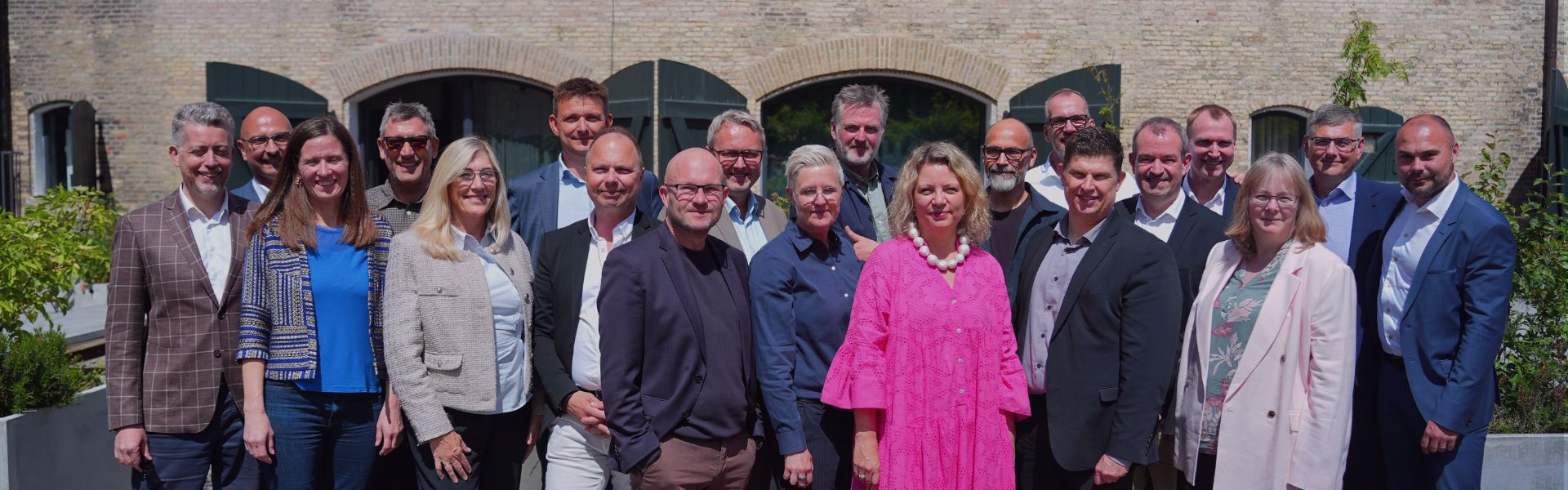
Five years ago, IT-Branchen gathered some of Denmark’s most experienced technology leaders in a network and asked them to be completely honest with each other. As the CIO Transformation Board celebrates its fifth anniversary, the conversations are more urgent and more honest than ever.
Take some of Denmark’s most experienced CIOs, gather them for a day of joyous five-year celebration and ask them a not so joyous, provocative question:
‘If we interviewed your successor five years from now, what would they say you never quite solved?’
No one hesitates. The conversations start immediately among them with honest thoughts shared openly. That is not a coincidence, because that is exactly what these people are here for.
They are all members of IT-Branchens CIO Transformation Board, bringing together CIOs from some of Denmark’s largest and most complex organisations, spanning industries as different as pharmaceuticals, energy, retail and humanitarian work.
In this room, they are not competitors. They are here because of a role that keeps rewriting itself, and a conviction that navigating it well requires something most professional networks do not offer: the space to speak completely openly.
‘What makes the CIO Transformation Board special is that we know each other well enough to have the truly honest conversations: about the crossroads we’re all facing in our organisations, the hard calls, and yes, the scars. It can be a lonely role. Having a confidential space where you can speak openly, across industries and without competition, is truly unique. That’s what makes this more than just another network. We’re here to genuinely develop the capabilities to lead not just as the CIO our organisations need today, but the one they’ll need tomorrow,’ says Susanne Thorskov Hansen, CIO, Group VP at Alfa Laval and Chair of the CIO Transformation Board.
Founded in crisis, but shaped by every curveball that followed
The board was founded in 2020, during covid, when CIOs suddenly found themselves at the centre of decisions no one had a playbook for. Remote infrastructure had to be built overnight. Continuity plans were tested in real time. And a role that had long operated somewhat in the background was suddenly very visible to their boards, to the employees and to society.
What no one quite anticipated was that the pressure would not ease once the pandemic did. Instead, new demands arrived in waves.
‘After Covid, sustainability landed on their desks, then came GenAI, and now geopolitics and digital sovereignty are taking up increasingly more space, with cyber and resilience never really leaving the agenda. But what has also changed is the role itself. A growing number of our CIOs now report directly to the CEO. The mandate has moved from running technology to being a core part of how the business is led. And developing the role was one of the fundamental ideas behind establishing the board,’ says Anne Sofie Josephensen, CCO at IT-Branchen,the architect behind the board and its facilitator since day one.
That last shift is perhaps the most significant: the CIO who sits at the leadership table today is not there merely to report on system uptime or project delivery. They are there to help shape the direction of the organisation by translating technological capability into business strategy, and to do it in language that lands visibly in the business. Five years ago, that was an aspiration for many in the role. Today, it is an expectation.
AI is everywhere and nowhere
You might expect a room full of CIOs to spend their time talking about systems, architecture and implementation roadmaps. Some of that happens. But what actually fills the room is something else: questions of trust, influence and what it really means to lead when the ground keeps shifting.
Take AI. ‘It is everywhere and nowhere at the same time,’ says Ann Fogelgren, CIO and Executive Leadership at GN Group and member of the Board, pointing at AIs presence in most organisations, generating energy and expectation at board level, but yet to find its real place in most businesses.
Some organisations have moved quickly and are already seeing results. Others are still working out where to begin. Either way, the task is the same: helping the rest of the executive team understand what AI actually requires in terms of data quality, organisational readiness, governance and culture, without losing any of it in the process.
Curveball leadership required
And AI is just one curveball among many.
The geopolitical landscape is reshaping foundations that many organisations assumed were stable. Digital sovereignty has moved from a compliance topic to a strategic priority. Dependencies that seemed unproblematic are being reconsidered. Employees in conflict zones, new regulations forcing directional changes, supply chains under pressure. Add to that cybersecurity threats that are growing more sophisticated by the month, IT solutions with shorter and shorter lifespans, and ambitious internal transformation programmes that sit on top of all of it: these are now part of the CIO’s remit in a way they simply were not five years ago. The speed of things coming the CIO’s way is unprecedented and requires an ability to catch some balls while dodging others.
‘You can’t plan as far ahead as we used to. Fundamentally, you must ditch the three-year plan and set direction for the next 90 days. Move closer together. And let go of the ways of working that no longer serve you. That’s what curveball leadership looks like in practice and it’s exactly what we spar with each other about on the CIO Transformation Board,’ says Ann Fogelgren.
That last point matters more than it might appear. The CIO Transformation Board exists precisely because the role can be an isolated one:
‘When you as a CIO are the person in the room who most fully understands the consequences of a given decision, and when the pace of change means those decisions come faster than ever, having a group of peers who can push back, challenge assumptions and share their own hard-won experience is not a luxury. It is part of what makes sustained leadership possible,’ says Anne Sofie Josephsen.
The next mountain
But complexity is not only a burden. René Rasmussen, CIO, Senior VP at Coloplast and member of the Board, has a clear sense of where the most ambitious CIOs are directing their attention.
‘I often talk about the next mountain of opportunity. For CIOs, that mountain is no longer just about implementing technology. It’s about helping the organisation navigate and capture the value of AI, data and digital capabilities in a world that’s changing faster than most boardrooms realise. But make no mistake: it is also the biggest opportunity the role has ever seen.’
Five years of conversations in the CIO Transformation Board have tracked that evolution in real time: across sectors, without competition and without the kind of careful positioning that tends to shape what people say in more public settings. Members have shared failures as openly as successes. They have borrowed each other’s thinking, challenged each other’s assumptions and, on occasion, helped each other find a way through situations that had no obvious answer.
The next mountain is already visible. And the CIO Transformation Board is ready to lead the climb.
Want to know more? Contact Anne Sofie to learn more about the CIO Transformation Board.
